

November 10, 2025

The headline may sound alarming, but the reality facing dental practices is even more sobering. Our Co-founder and Chief Sales Officer, Paul Murphy, recently sat down with Adrian Lefler on the Byte Sized Podcast to discuss the evolving cybersecurity threat landscape in dentistry.
With over 25 years of experience in healthcare technology and having implemented preventative security solutions in over 1,000 healthcare facilities worldwide, Paul shared insights that cut through the noise and addressed what really matters: protecting your practice, your patients, and your livelihood.
The Evolution of Ransomware: A New Kind of Threat
Ransomware attacks have fundamentally transformed. The attacks of five years ago were manageable if practices maintained good backups. Today's reality is far more dangerous.
Modern cybercriminals employ what Paul described as "Ransomware 3.0," featuring double and triple extortion methodologies. Criminals silently infiltrate your network and steal your entire patient database before you know anything is wrong. They publish stolen data on dark web auction sites as proof of the breach. Only then do they encrypt your systems and start the clock.
The minimum ransom demand for a single-location dental practice today is $100,000. But here's what makes this particularly devastating: attackers often locate your cyber insurance policy and bank statements on your network before setting their demands. They know exactly what you can afford to pay.
Class Action Law Firms Are Watching
Perhaps the most alarming revelation involves predatory behavior emerging around data breaches. Class action law firms now actively monitor dark web auction sites where stolen dental data appears. Sometimes they discover breaches before practices themselves know.
As Paul explained:
"You're talking about healthcare providers who are victims of criminals. You're the victim of a crime, and now you're being painted as a potential criminal."
A solo practitioner can experience ransomware, close for weeks, and then face a class action lawsuit on top of everything else.
Two Primary Attack Vectors
Dental practices face two main entry points for cybercriminals.
Social engineering accounts for 60-65% of breaches. Modern criminals leverage AI tools to craft sophisticated, dental-specific phishing emails. They research terminology, study communication patterns, and create messages appearing legitimate even to trained eyes.
Technical vulnerabilities represent 35-40% of breaches. These are open doors on every device connected to your network. Without continuous monitoring and vulnerability scanning, these entry points remain exploitable.
Three Critical Questions Every Practice Must Answer
If you're evaluating whether your practice is protected from cyber threats when implementing AI, here are three questions to answer immediately:
First, do you have cyber insurance specifically? General business interruption policies rarely cover cyber events adequately. Practices are far more likely to face cyber attacks than fire, flood, or malpractice claims.
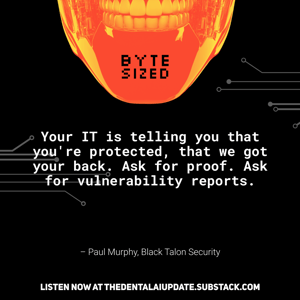
Second, has your IT provider proven they're protecting you? When IT companies say "we've got you covered," ask for vulnerability reports. Dentists make data-driven decisions about everything except cybersecurity, where they inexplicably rely on feelings.
Third, have you empowered your team? Without cybersecurity awareness training, you cannot hold employees accountable for clicking malicious links.
The Hidden Costs Beyond Ransom
The ransom payment is often the smallest expense in a breach scenario. The true financial devastation unfolds in layers that many practice owners never anticipate.
Business closure during recovery can stretch for weeks. Patient notification fees mandated by HIPAA compliance requirements add up quickly when you're contacting thousands of affected individuals. Complete computer replacement becomes necessary when attacks prove too devastating for system recovery. Specialized forensics investigations, which only certified firms can perform, don't come cheap. Legal fees for navigating HIPAA reporting requirements and potential Office for Civil Rights inquiries compound the damage. And looming over everything is the threat of class action settlements from patients whose data was compromised.
Beyond the financial impact, HIPAA violations resulting from a breach can trigger additional fines ranging from $100 to $50,000 per violation, with annual maximums reaching $1.5 million per violation category. Practices must demonstrate they had reasonable safeguards in place, and "we trusted our IT company" isn't a defense regulators accept.
The psychological toll cannot be understated. Practice owners who learn criminals watched their every action for weeks often experience lasting trauma. Some practitioners have told us they simply don't want to continue after experiencing a breach. These aren't just business disruptions. They're life-altering events.
The Time to Act is Now
The dental networks Paul described as "held together by band-aids and dental floss" require specialized protection. As he put it: "If they're the general dentist, we are the oral and maxillofacial surgeon."
For practices still operating on assumptions, consider this your wake-up call. Listen to the full episode of the Byte Sized Podcast for additional insights. When you're ready to stop guessing and start protecting, contact our team.